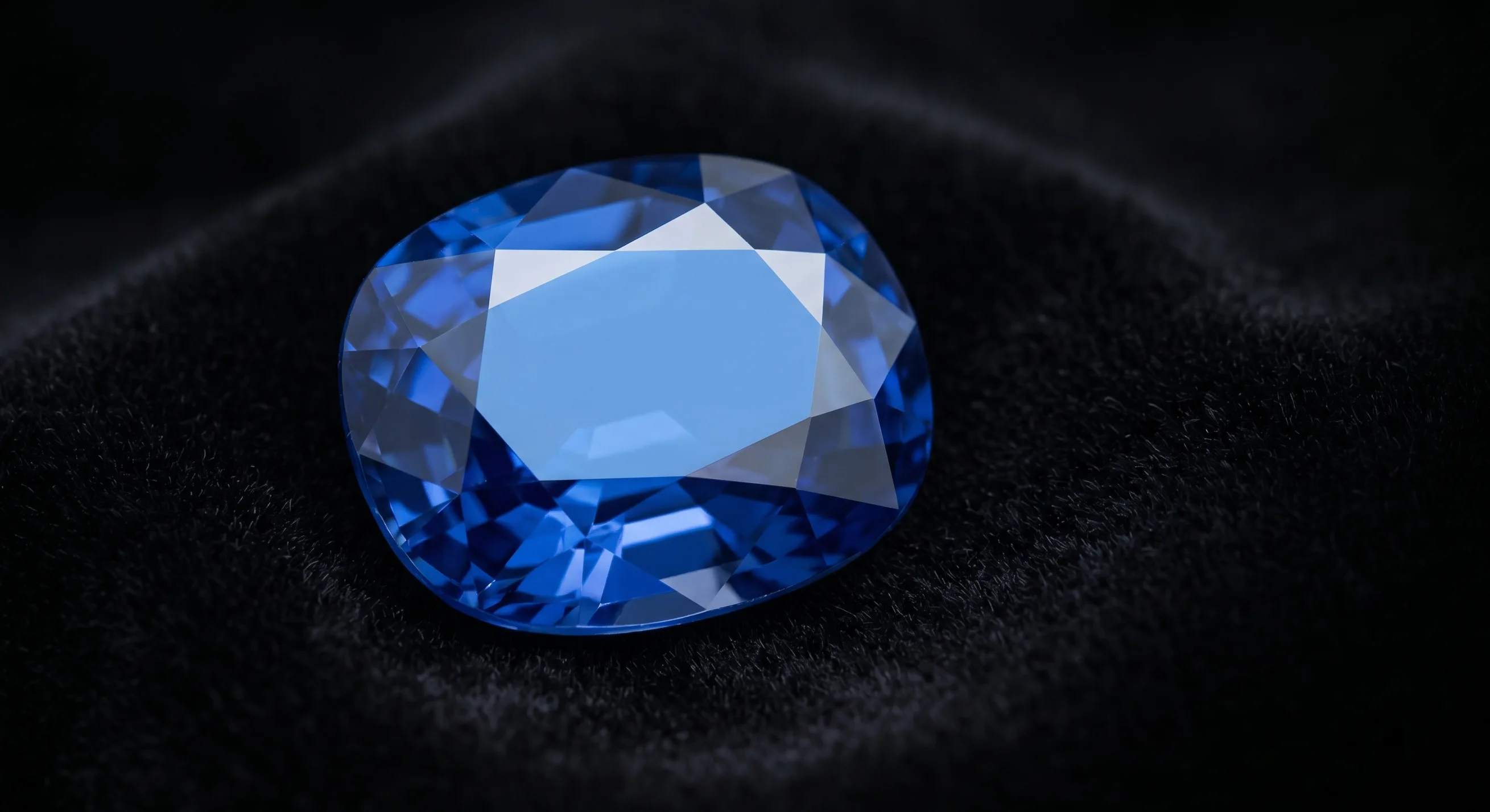
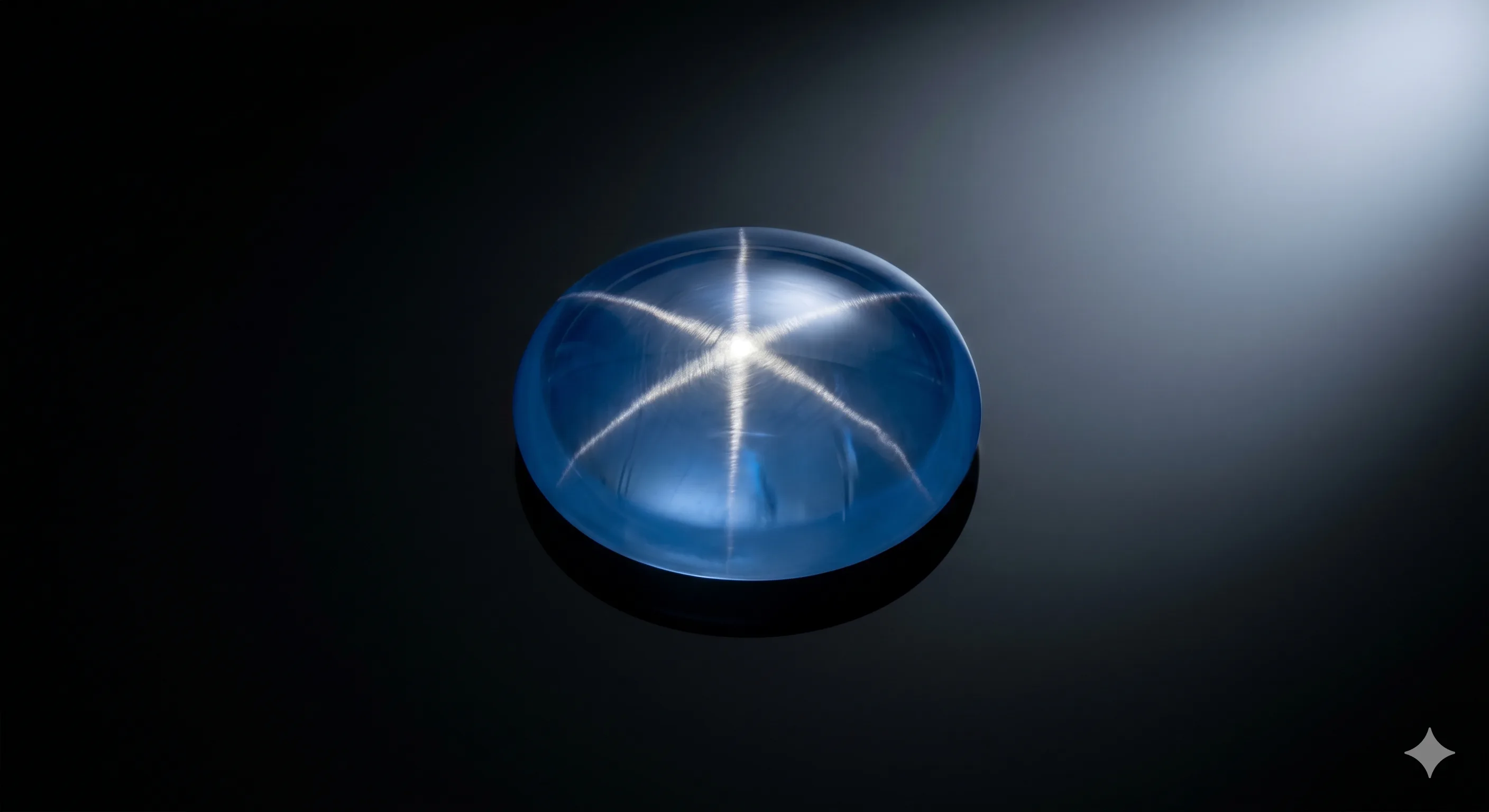
Sri Lankan gem cutters are still considered the best in the world because they cut by eye, prioritise colour and weight retention over factory symmetry, and use slow hand-driven laps that give a finished sapphire life rather than just sparkle. Most other cutting centres optimise for speed and standardisation. Sri Lankan cutters optimise for what each individual piece of rough actually wants to become. The result is a finished stone that shows more colour face-up, retains more carat weight from the original crystal, and reads as a gem cut by a person rather than a machine. That difference is small in a photograph and very obvious in the hand.
This is why fine sapphire dealers from New York to Geneva still send their best rough back to Sri Lanka to be cut, even though it would be cheaper to have it done in Bangkok or Guangzhou.
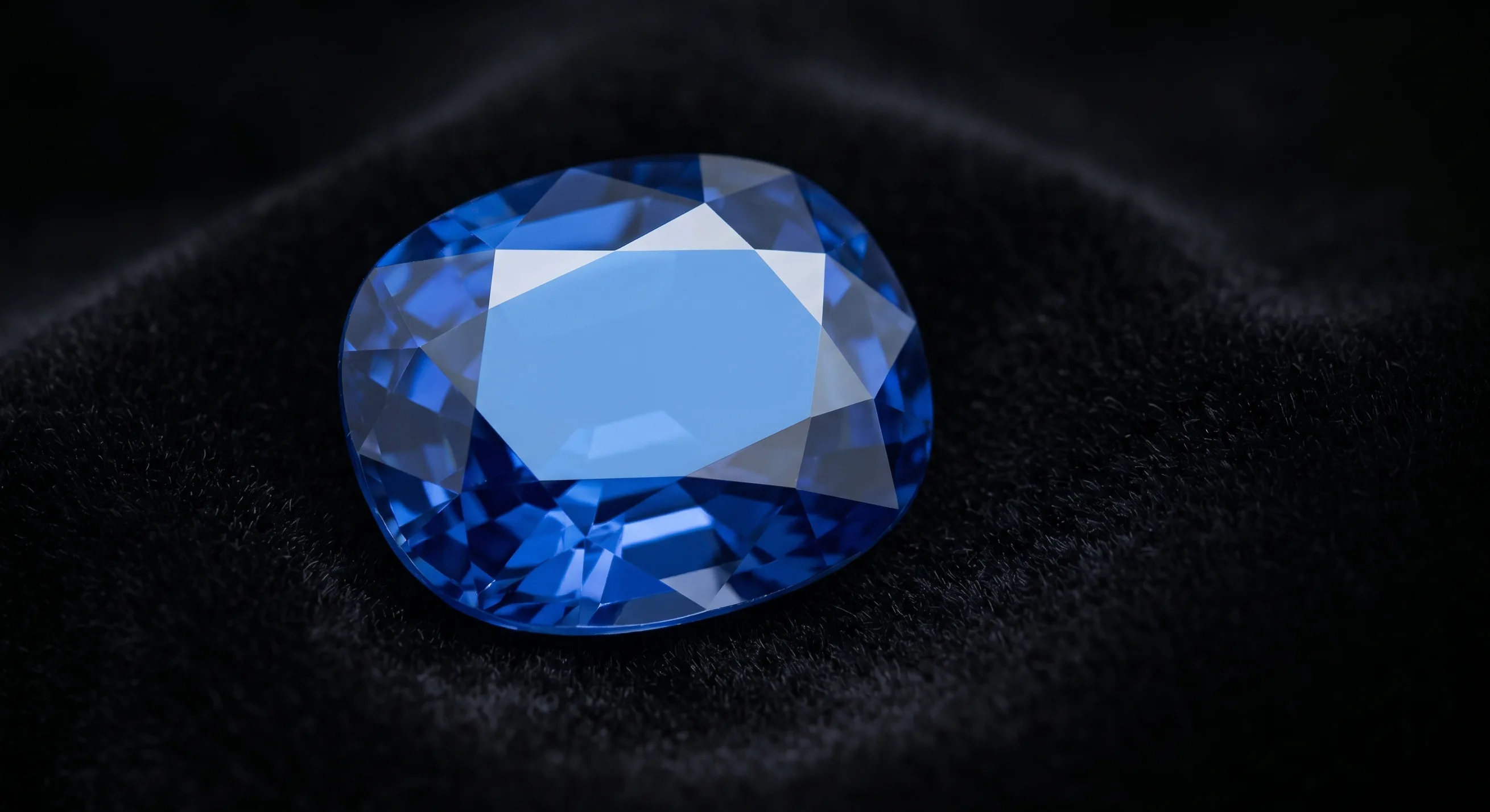
What Makes Sri Lankan Gem Cutting Different from Other Centres?
Most of the world's coloured stones are cut in a handful of places: Bangkok, Chanthaburi, Jaipur, Guangzhou, and Sri Lanka. Bangkok and Chanthaburi cut at scale, in large workshops, on calibrated parcels (6×4 ovals, 7×5 ovals, 5×3 marquises) to standard depth and angle. That is what the global mass jewellery trade buys, and Thai cutters do it brilliantly. Jaipur and Guangzhou serve different ends of the same throughput logic: high volume, increasingly machine-assisted, optimised for predictable yield.
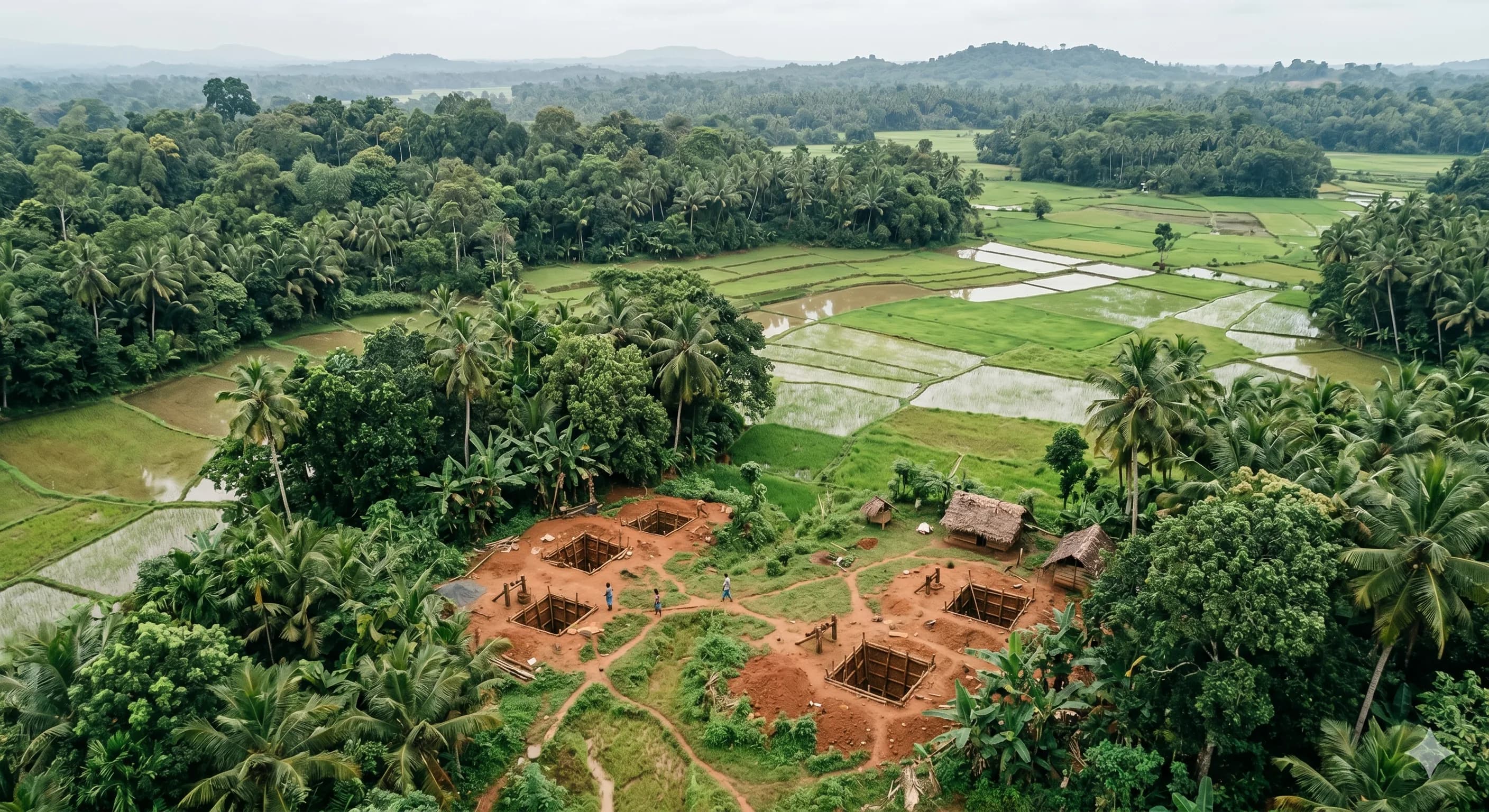
Sri Lanka is different. Most workshops are small, often a single lapidary at a single horizontal lap, sometimes with one apprentice. The finest sapphires, including most fine padparadscha, most royal-blue Ceylon, and a large share of the world's unheated cornflower material, are cut in these small workshops in Beruwala and Ratnapura. The cutter sees the rough out of the ground, often within a few miles of where it was washed out of the illam, and the cutting decision is made on that specific stone with no production schedule pressing behind it.
How Are Sapphires Hand Cut in Sri Lanka?
A hand cut sapphire follows roughly the same path as a machine cut one: study the rough, mark the orientation, preform, facet, polish. What changes is the tooling and the judgement.
A Sri Lankan cutter usually works on a horizontal lapping wheel, often a single flat copper or tin lap charged with diamond grit, sometimes followed by a softer polishing lap. The stone is mounted on a dop stick using shellac or modern dop wax. The cutter holds the dop in their fingers and lowers the stone onto the spinning lap, judging the angle by feel against a wooden support post or a simple jamb peg. There is no indexed faceting head with a click stop for every facet. The angle is set by the cutter's hand and corrected by the cutter's eye.
This is what the trade means by traditional lapidary cutting. The cutter is not following a software-generated design. They are reading the rough, choosing where the colour sits strongest, deciding where to put the table to keep the most weight, and then bringing each facet to the lap one at a time, checking colour and meet-points after every pass.
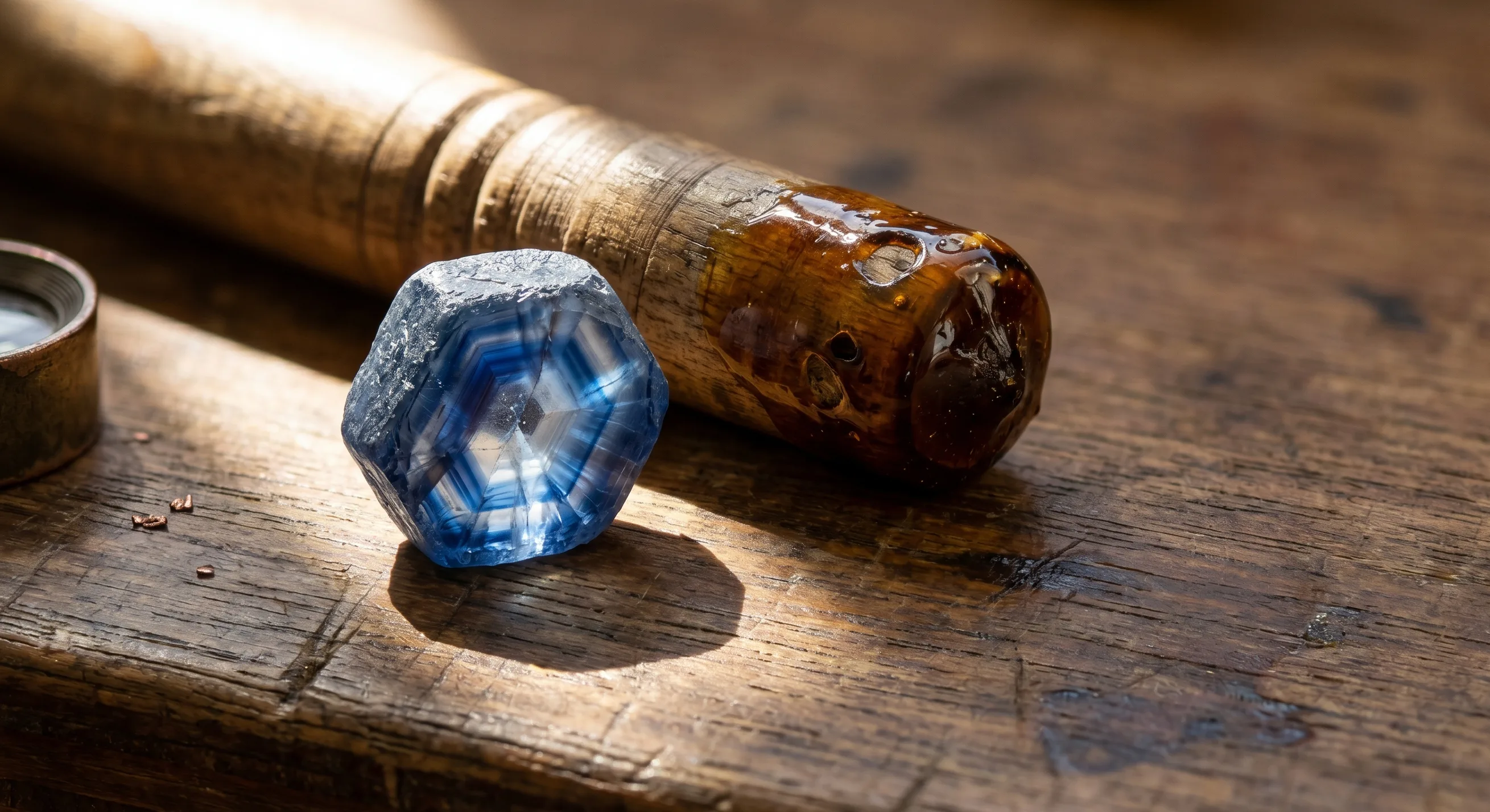
For a fine Ceylon sapphire, the cutter spends more time looking at the rough than grinding it. Sapphire is dichroic: it shows two different colours along its two main optic axes. In a Ceylon stone, one axis often shows a slightly greyer or greener blue and the other a cleaner cornflower or royal blue. The cutter's first job is to find the axis that maximises the desirable colour and put the table perpendicular to it. Get this wrong and you have ground a clean stone into a mediocre face-up.
Why Do Sri Lankan Cutters Still Use Traditional Laps?
The fair question is the obvious one: if precision faceting machines exist, why not use them?
The honest answer is that precision faceting machines are excellent at producing identical stones to the same recipe, and almost every fine Ceylon sapphire is not identical to any other. The rough is too varied. Colour zoning shifts from one part of a crystal to another. Inclusions sit where they sit. The crystal habit of corundum, hexagonal and often tapered, rarely lends itself to a clean calibrated outline. A factory cut loses more weight than necessary because the machine is following a target shape rather than the stone's own geometry.
A Sri Lankan cutter working by hand can do something a machine cannot: stop the cut, hold the stone to the light, see that the blue is dropping out of one corner, and tilt the orientation by half a degree to recover it. They can decide mid-cut that the stone wants to be a 2.18 carat slightly off-square cushion rather than the 1.94 carat perfect oval the original plan called for. Those decisions are worth real money on stones over a carat, where price scales sharply with weight.
What Is "Ceylon Precision Cutting" If Not Machine Cutting?
The phrase ceylon precision cutting gets thrown around in jewellery marketing and it does mean something specific, even though it can sound like a contradiction with the traditional-by-hand reality above.
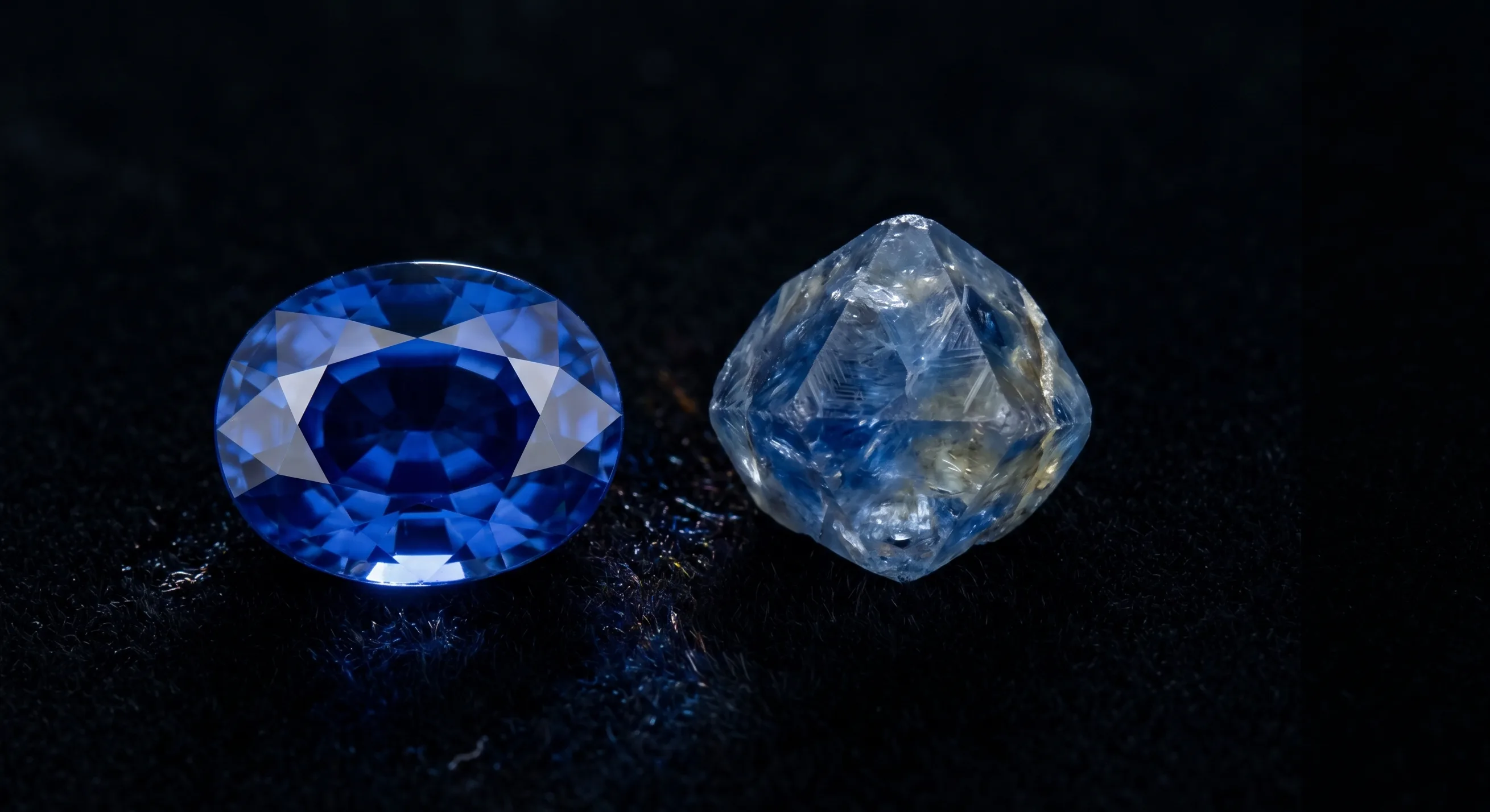
Ceylon precision cutting refers to the standard of finish and proportion that the best Sri Lankan workshops have settled on for fine coloured stones. Tight meet-points where adjacent facets converge. Polished facets with no scratches visible at 10× magnification. Crown and pavilion angles tuned to the refractive index of corundum so light returns through the table rather than leaking out the bottom. A girdle that is even and proportioned, not knife-edge and not chunky.
What it is not: indexed-mechanical perfection in the sense of identical machine-set facet angles. The "precision" is in the standard of finish and in the correctness of the optical proportions, judged and executed by hand. A skilled Sri Lankan lapidary will hold tolerances on a fine sapphire that a machine will improve on only marginally, and the tradeoff in lost weight or muted colour is almost never worth that marginal improvement.
The best workshops in Beruwala can produce hand cut sapphire work that is indistinguishable from machine cutting under a loupe in terms of polish and meet-points, while still preserving the colour and weight advantages of cutting by eye. That combination is what the phrase is pointing at.
Where Do the Best Cutters Work in Sri Lanka?
There are three concentrations.
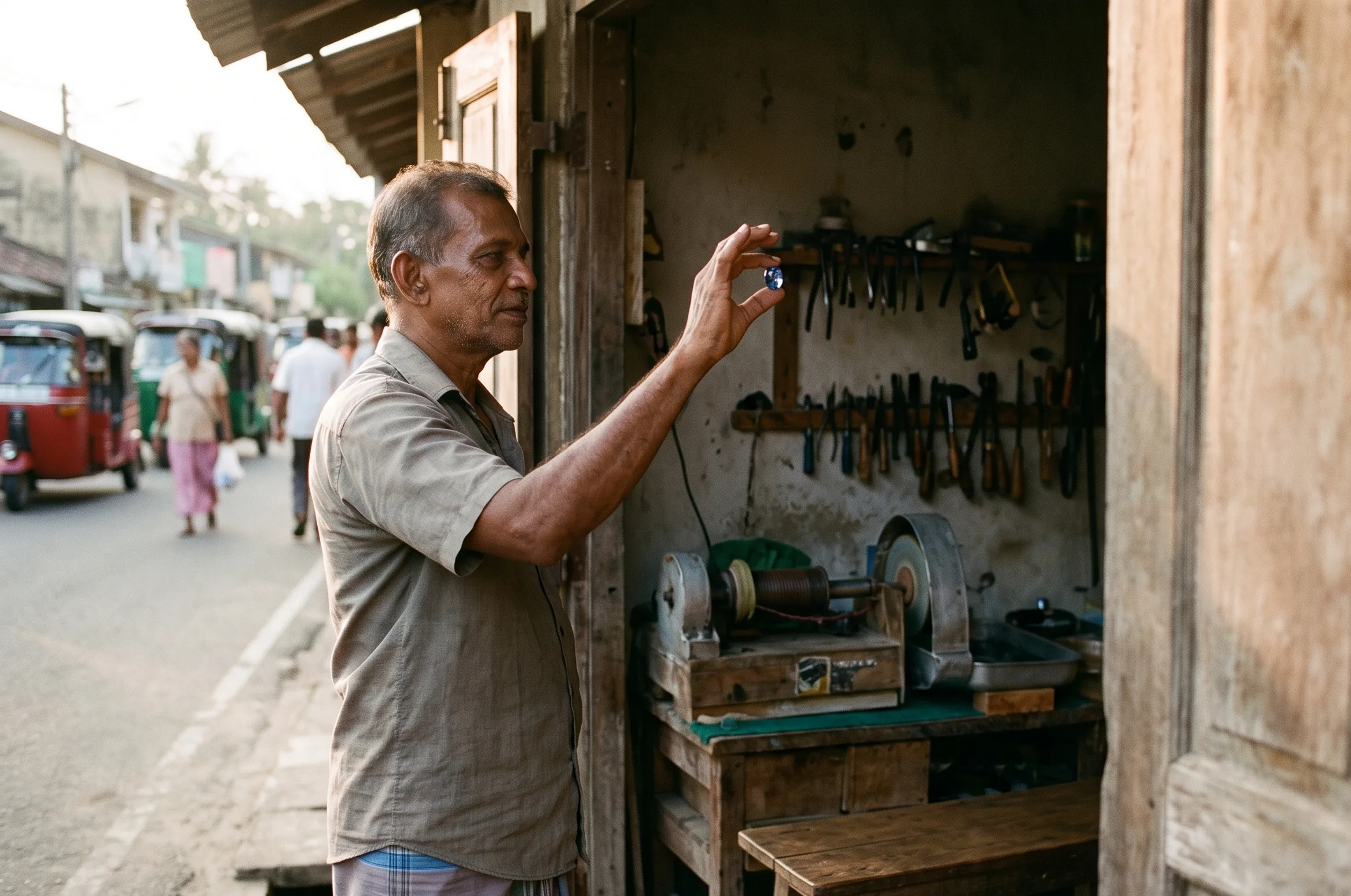
Beruwala. A coastal town about 60 kilometres south of Colombo, and probably the single largest concentration of high-end coloured-stone cutting in the world. Walk a few streets behind the main gem market and you will pass workshop after workshop, often a single cutter at a single lap, doors open to the street. Beruwala is where most of the international rough cycles through.
Ratnapura. The mining heartland is also a cutting heartland. Cutters here are often part of the same family network as the miners, and the rough does not always travel far from the pit where it came out of the illam. Some of the best unheated material is cut within a few kilometres of where it was mined.
Colombo. A smaller centre, but home to several established workshops that work primarily for international dealers and for the high-end local market. The very best cutters, the ones whose names move quietly between dealers and never appear on a website, almost all work in Beruwala or Ratnapura.
How Can You Tell If a Sapphire Was Hand Cut by a Sri Lankan Lapidary?
There are three signs, none definitive on their own but persuasive together.
Slight asymmetry that serves the stone. Look down through the table. A hand cut Ceylon sapphire will often have a culet that sits very slightly off-centre, or pavilion mains that are not perfectly equal in length. This is not poor cutting. It is the cutter following colour and weight rather than geometry.
Strong face-up colour that holds across the stone. Tilt the stone in good daylight. A well-oriented hand cut sapphire holds its blue across most of the crown with only a small extinction window in the centre. A poorly cut stone shows a wide silvery patch where the colour drops out.
Weight that is unusual for the size. A 6.5×5.5 mm oval cut in Beruwala will often weigh 1.20 to 1.30 carats; the same outline in a Thai factory will weigh closer to 1.00. The extra weight is real corundum, paid for at the same per-carat price.
For more on what a lab report tells you about a stone's origin and treatment, see the guide to authenticating a Ceylon sapphire.
A Visit to a Cutter's Workshop
The first time I sat in a cutter's workshop in Beruwala, the thing I remember most was how quiet it was. A single low-ceilinged room with the door open to the street, an electric lap turning at maybe 1,500 rpm with no real noise to it, and an older man in a sarong leaning over a 4-carat blue rough with a loupe.
He had been turning the same piece of rough for almost an hour without touching the wheel. There was a small notebook on the bench with orientation sketches. He was not in any hurry. The stone, he told me later through a dealer who translated, was probably going to cut a 2.6 to 2.8 carat cushion, certainly unheated, and he was not willing to commit the table direction until he was sure. He took the stone to the doorway, looked at it in daylight, came back, looked at it under the bulb, marked it in pencil, and only then turned to the lap.
That morning is the thing I think about whenever someone asks me why we cut in Sri Lanka. It is not nostalgia. It is the fact that no faceting head will ever stand in a doorway and take a piece of corundum into daylight before deciding which face to put down. The whole logic of Crestonne's sourcing model is built around that step happening properly, in the country where the stone came out.
Why It Matters When You Are Buying
Most buyers will never inspect the cut of their sapphire under a loupe, and that is fine. The point is that the cutting decision was made for the colour and life of the stone, not for the throughput of a workshop, and that difference shows up in the way the gem reads on a finger across a dinner table.
If you are choosing a sapphire for an engagement ring, this matters more than almost any variable except origin and treatment. A well-cut 1.50 carat Ceylon sapphire will out-perform a poorly-cut 2.00 carat stone of equivalent material, in face-up colour, in life, and in the way it actually wears.
If you are sourcing a stone to specific criteria, tell us what you are looking for and we will work with cutters in Beruwala and Ratnapura to find the right rough and orient it correctly. The cutting fee is small relative to the stone. The cutting decision is everything.