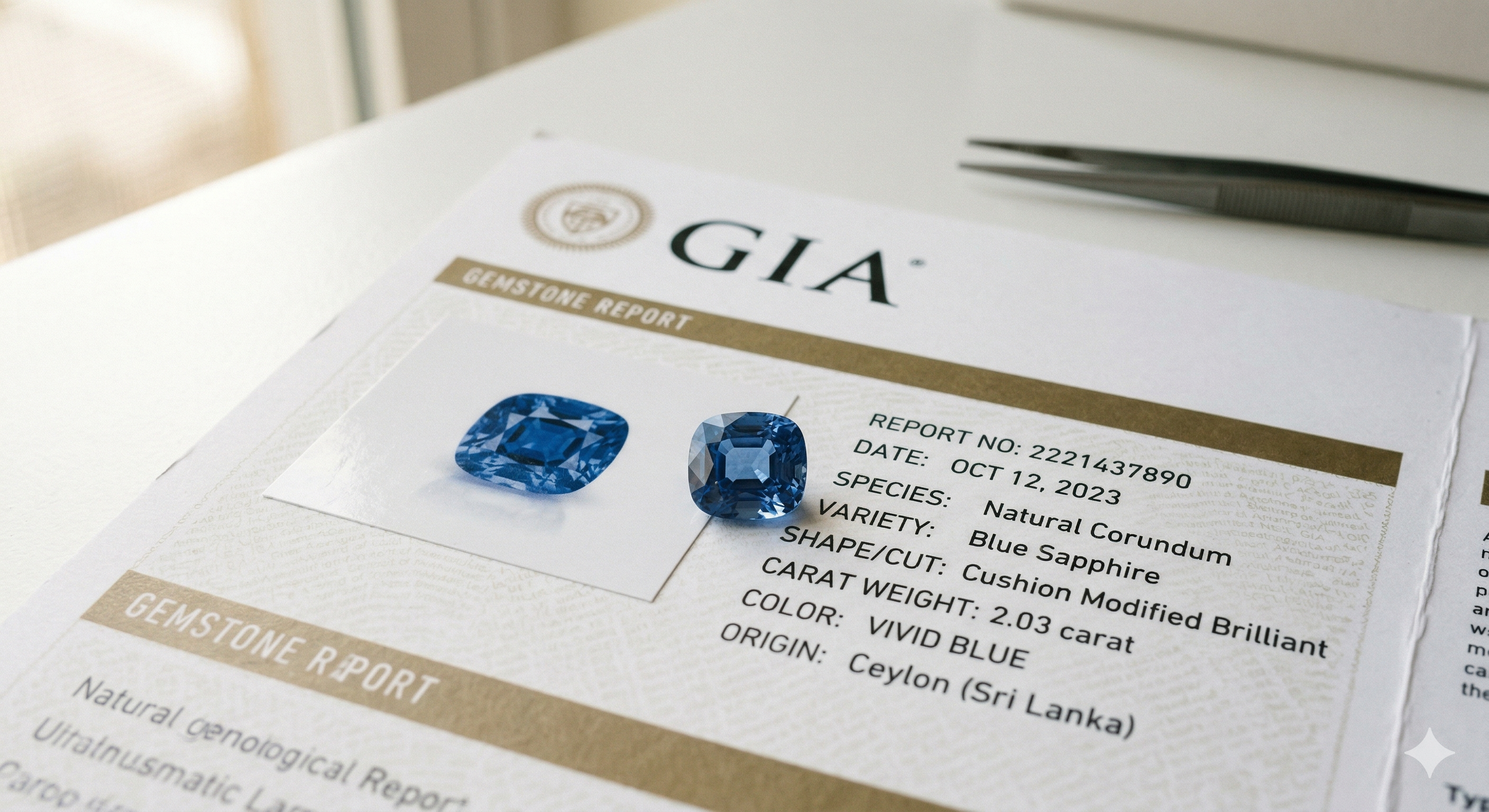
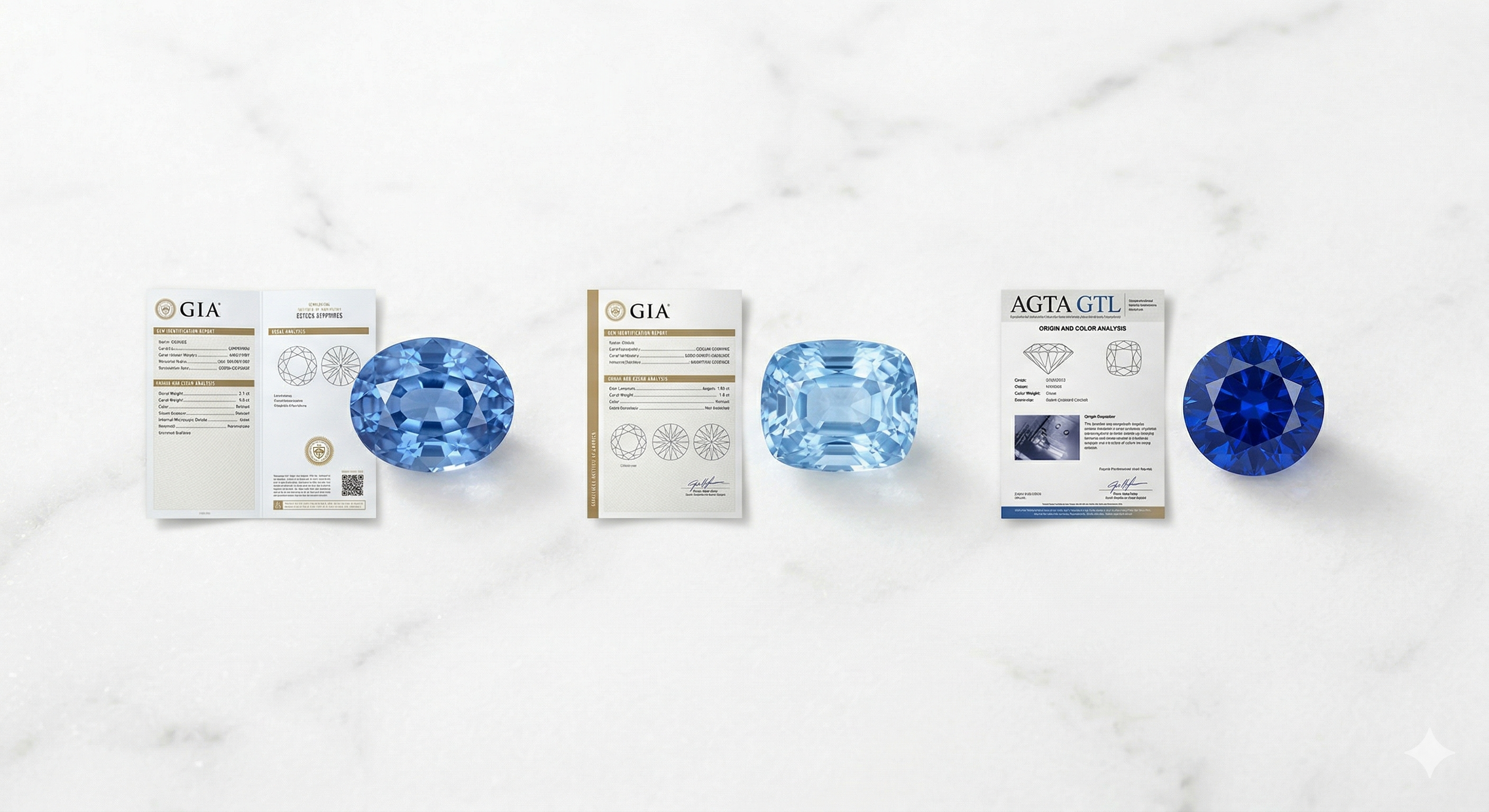
The most reliable way to tell if a Ceylon sapphire is real is to read the laboratory report. A genuine Ceylon sapphire will have a document from GIA, SSEF, or Gübelin that states "Sri Lanka" under geographic origin. Everything else (color, inclusions, UV fluorescence) is useful context, but none of it is proof. If a seller cannot provide a report from one of those three laboratories, you are buying an unverified stone regardless of how compelling the pitch.
Here is how to work through each Ceylon sapphire authenticity test, from the first look to final confirmation.
What Does a Genuine Ceylon Sapphire Look Like?
Ceylon sapphires have a recognizable color profile, but color alone cannot confirm origin. Stones from Madagascar, Tanzania, and parts of Australia can closely resemble classic Ceylon blue. Well-cut synthetic corundum can look even more perfect.
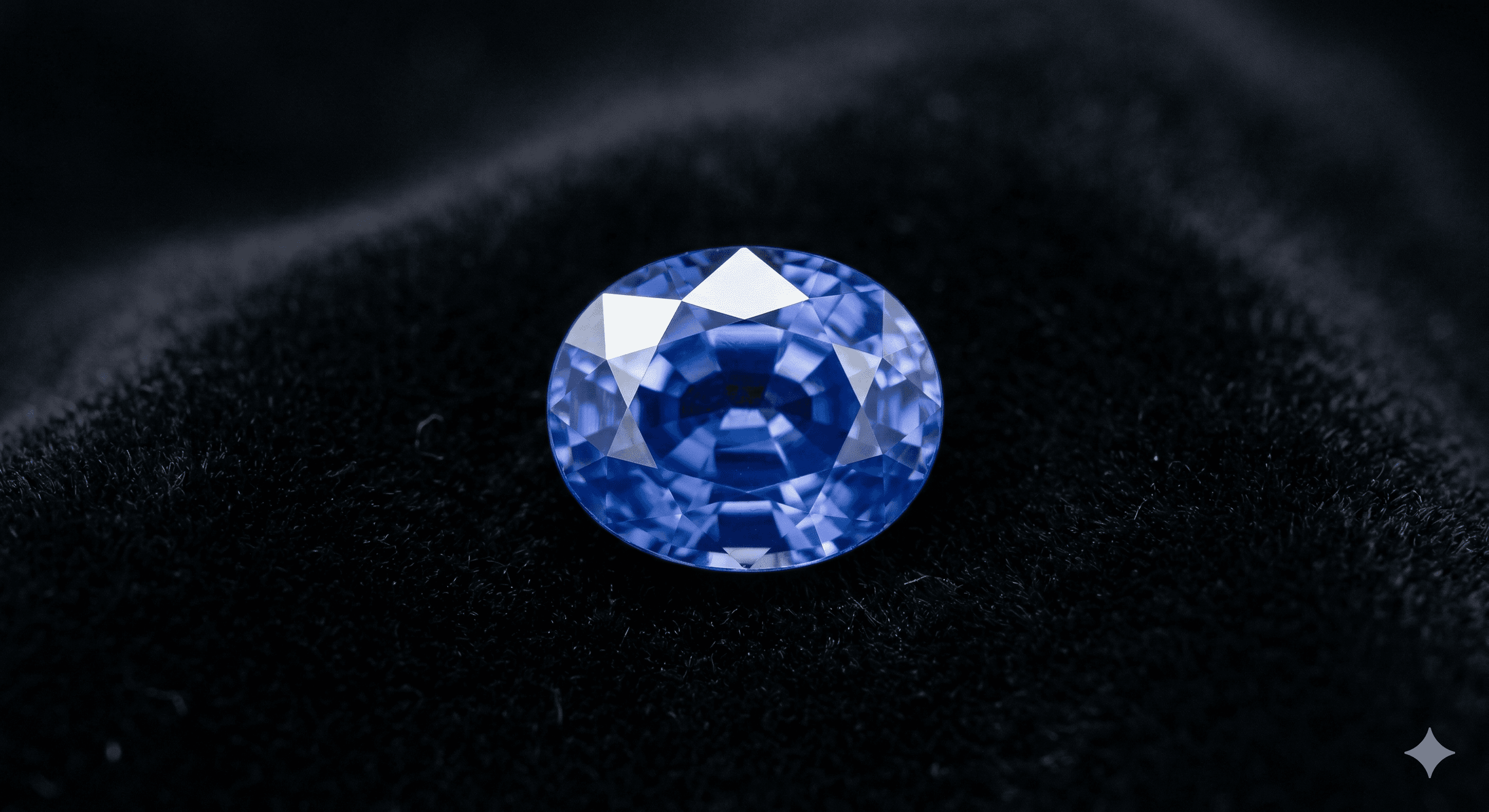
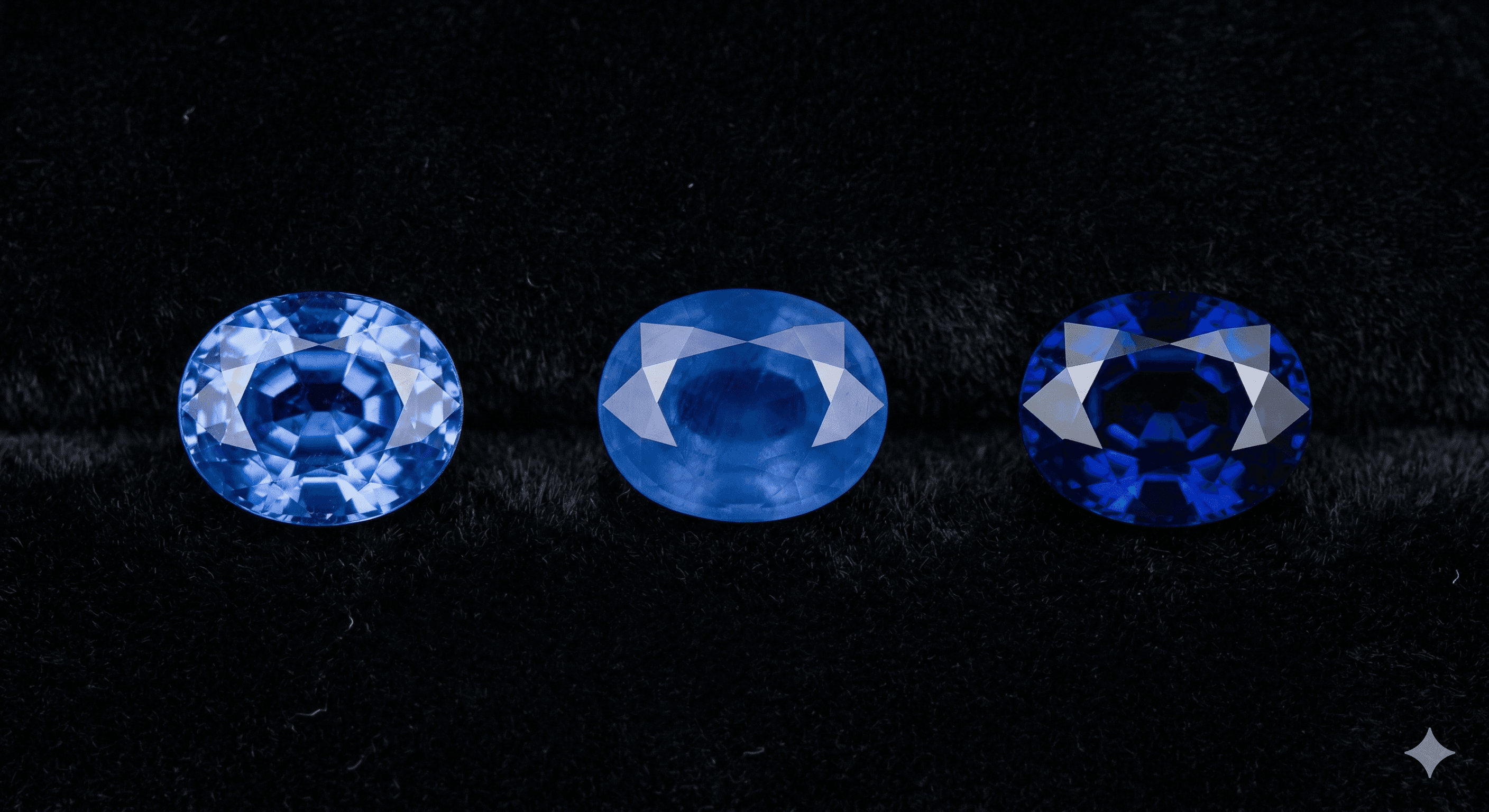
The signature Ceylon color is a medium to medium-dark blue with a violet secondary hue. The tone sits in the middle of the scale: not the inky, almost navy-black of some Thai or Australian material, and not the washed-out, milky lightness of low-grade stones. The saturation is strong but not overwhelming. In incandescent lighting, fine Ceylon sapphires tend to look warmer and more alive than they do under daylight, a quality dealers sometimes describe as "velvety."
Under long-wave UV light, many Ceylon sapphires fluoresce a distinctive orange-red. This happens because of trace chromium in the crystal structure. It is a useful observation, since most sapphires from other origins either show weak fluorescence or none at all, but it is not conclusive. Some genuine Ceylon stones show no fluorescence. Some non-Ceylon stones do. Treat it as a supporting data point, not a test.
Which Inclusions Are Associated with Ceylon Sapphires?
Under 10x magnification, experienced gemologists look for specific inclusion types that are common in Sri Lankan corundum. None of these confirm origin on their own, but their presence (or absence) adds to the picture.
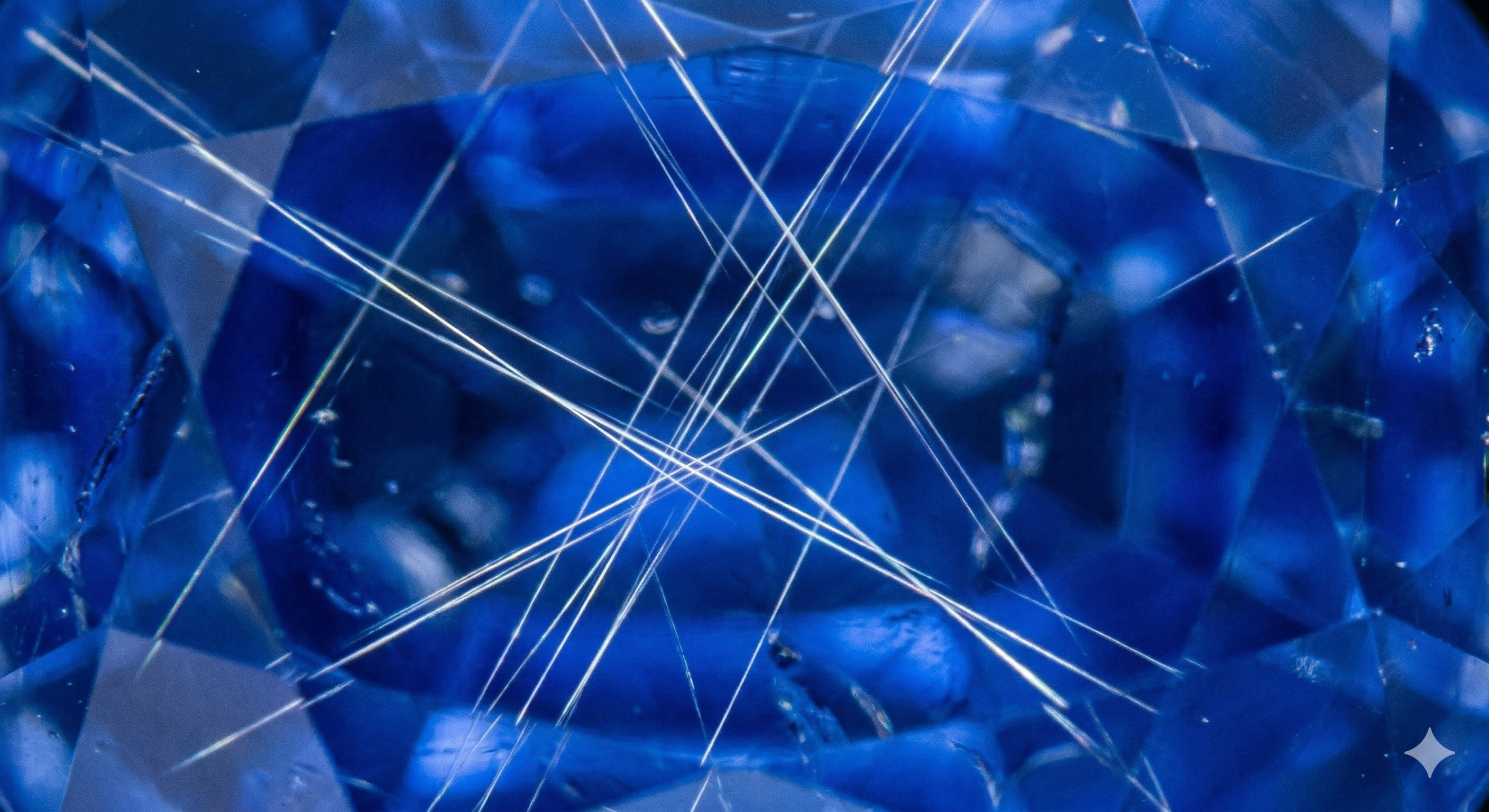
Silk. Fine, needle-like rutile inclusions arranged in intersecting sets at 60-degree angles. Well-defined silk is strongly associated with unheated Ceylon material. Heating dissolves or disrupts silk, so its presence suggests a stone has not been treated. A stone with intact, sharply defined silk and no other signs of heating is a good candidate for a "no indications of heating" laboratory result.
Fingerprint inclusions. Healed fractures that resemble the whorls of a fingerprint, filled with liquid or gas. These appear across many sapphire origins but are frequently seen in Ceylon goods. By themselves they tell you very little about origin.
Color zoning. Uneven distribution of color in straight bands or angular zones following the crystal's hexagonal growth structure. Ceylon sapphires often show distinct alternating blue and near-colorless zones. Under magnification, this angular zoning is different from the curved zoning seen in synthetic stones, which is a useful distinction.
Negative crystals. Cavities in the shape of the host crystal, sometimes containing a small amount of liquid or a gas bubble. Common in Sri Lankan material.
What the laboratories actually use to determine origin is trace element chemistry. GIA, SSEF, and Gübelin measure the ratios of iron, titanium, chromium, gallium, and magnesium using techniques including infrared spectroscopy and laser ablation mass spectrometry. The inclusion picture supports but does not substitute for that analysis.
Why Visual Checks Alone Cannot Verify a Ceylon Sapphire
Early in the process of building Crestonne's sourcing network, we were shown a stone by a dealer in Colombo. The color was exceptional, a vivid cornflower blue that held its saturation across different lighting conditions. The seller was experienced and the asking price, while high, was not implausible for the size.
Under UV, the fluorescence looked right. Under magnification, we could see what appeared to be fine silk. The color zoning was angular, consistent with natural corundum. Every visual cue pointed toward genuine unheated Ceylon material.
We sent it to a laboratory before committing to purchase.
The report came back: indications of heating. Origin: inconclusive, most consistent with East African localities. What we had interpreted as silk under magnification was a different inclusion type that resembles rutile needles under certain lighting conditions. The fluorescence, while visually similar to Ceylon material, had spectroscopic characteristics that pointed elsewhere.
The stone went back. The laboratory fee was a few hundred dollars. The stone was priced at five figures.
This is not an unusual story in the gem trade. It is why a laboratory report is the only number that matters.
How to Read Heat Treatment Disclosure on a Lab Report
A GIA Colored Stone Report, SSEF Report, or Gübelin Report will include a clarity or treatment field. The language varies slightly by laboratory, but the categories are consistent.
"No indications of heating" is the designation that commands a significant price premium. The laboratory found no evidence of heat treatment. This matters because unheated Ceylon sapphires of fine color are genuinely rare. Most of the sapphire supply, including most of what comes out of Sri Lanka, is heated before it reaches market. Understanding exactly what this phrase means and what the lab is looking for is worth your time before you pay the premium for it.
"Indications of heating" means the stone shows evidence of having been heat-treated. This is not a defect. Heating is a stable, permanent treatment that does not require ongoing care or disclosure at resale in the same way fracture filling does. The vast majority of sapphires on the market are heated. What matters is that it is disclosed and reflected in the price. The actual price difference between heated and unheated Ceylon sapphires of equivalent color can be substantial, often two to five times, and worth understanding before you negotiate.
"Indications of fracture filling" means a foreign substance has been introduced into surface-reaching fractures to improve apparent clarity. This is a more invasive treatment, less stable over time, and one that should be accompanied by a lower price and fuller disclosure from any responsible seller.
If the report does not address treatment explicitly, ask why. Every reputable laboratory report for a colored stone includes treatment disclosure. Its absence is unusual and worth questioning.
Can You Trust the Photos?
Sapphire color is notoriously difficult to photograph accurately. It shifts under different lighting conditions, and post-processing can deepen saturation or shift hue with a single slider. This is why you should never evaluate a stone on photos alone, regardless of where you are buying.
What separates a responsible seller from a careless one is how they handle this limitation. At Crestonne, every stone is photographed under consistent, daylight-balanced lighting with no color correction. We list the certificate number alongside each stone so you can verify it against the laboratory's online database. That step takes two minutes and eliminates a meaningful category of fraud. If you want a video of a stone rotating under natural light before you commit, we provide one.
When buying from any seller, ask these questions: Is the certificate number listed and verifiable? Does the seller offer images under controlled, consistent lighting? Will they provide a video? A seller who does these things is working to close the gap between what you see on screen and what arrives. A seller who does not is hoping the gap works in their favour.
Red Flags That Should Make You Walk Away
No certificate, or a certificate from a lab you cannot verify. GIA, SSEF, Gübelin, AGL, and Lotus Gemology are the recognized names in origin determination. A certificate from a regional lab with no online verification database is not evidence of anything. Fake sapphire identification starts here. Without a verifiable report, you have no way to distinguish a genuine stone from a well-cut synthetic or a misrepresented origin. Be particularly cautious with certificates that are laminated, handwritten, or do not include a report number you can verify.
Pricing that is far below the market rate. A genuine unheated Ceylon sapphire of two carats with strong color and a SSEF report confirming Sri Lanka origin does not sell for $600. If the price seems impossible for what is being claimed, the claim is almost certainly wrong. The gemstone market is not consistently mispriced in favor of the buyer.
Resistance to independent laboratory verification. Any seller who objects to you sending a stone to a laboratory before purchase (at your cost, through your chosen lab) is telling you they expect the laboratory result to change your mind. A seller confident in their goods welcomes the certificate.
"Ceylon quality" as a substitute for "Ceylon origin." The phrase "Ceylon quality" or "Ceylon color" describes a color profile, not a geographic origin. It is technically accurate as a description and deliberately misleading as a sales term. Only a geographic origin field on a laboratory report confirms Sri Lanka provenance.
The certificate photograph does not match the stone. GIA reports include a photograph of the examined stone. If a seller will not place the certificate next to the stone so you can compare facet patterns and weight, that is a significant concern.
Where to Buy a Certified Ceylon Sapphire
Every stone in the Crestonne collection is listed with its laboratory report, treatment history, and origin determination. Nothing is described without documentation to support the description.
If what you are looking for is not currently available (a specific color range, carat weight, shape, or treatment status), the Crestonne custom sourcing service lets you submit a brief. We search our established network in Ratnapura and Elahera, present options with full documentation, and you make the decision with no obligation to purchase.
The certificate should come before the price discussion. That sequence is not a courtesy. It is the foundation of an honest transaction.