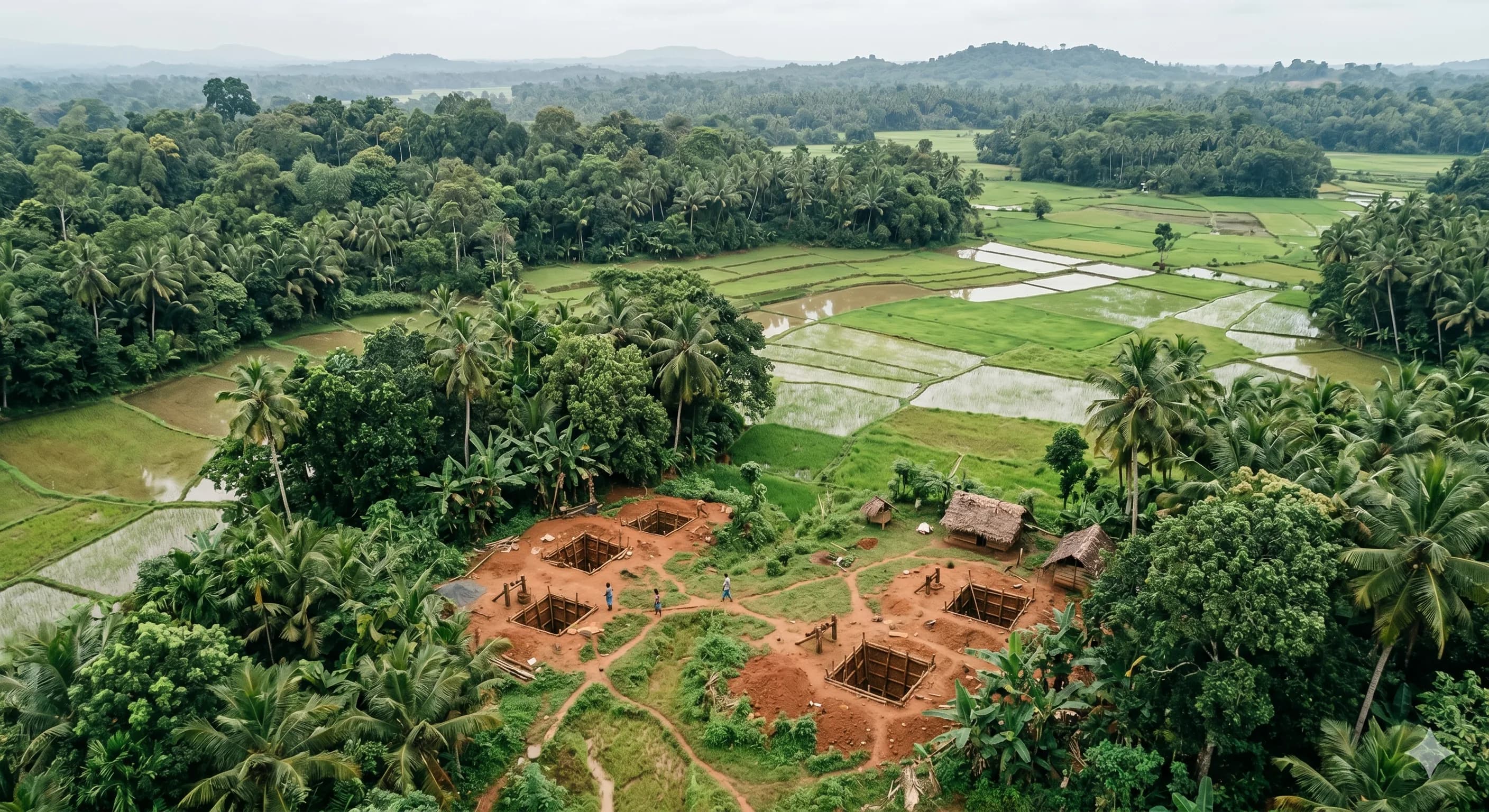
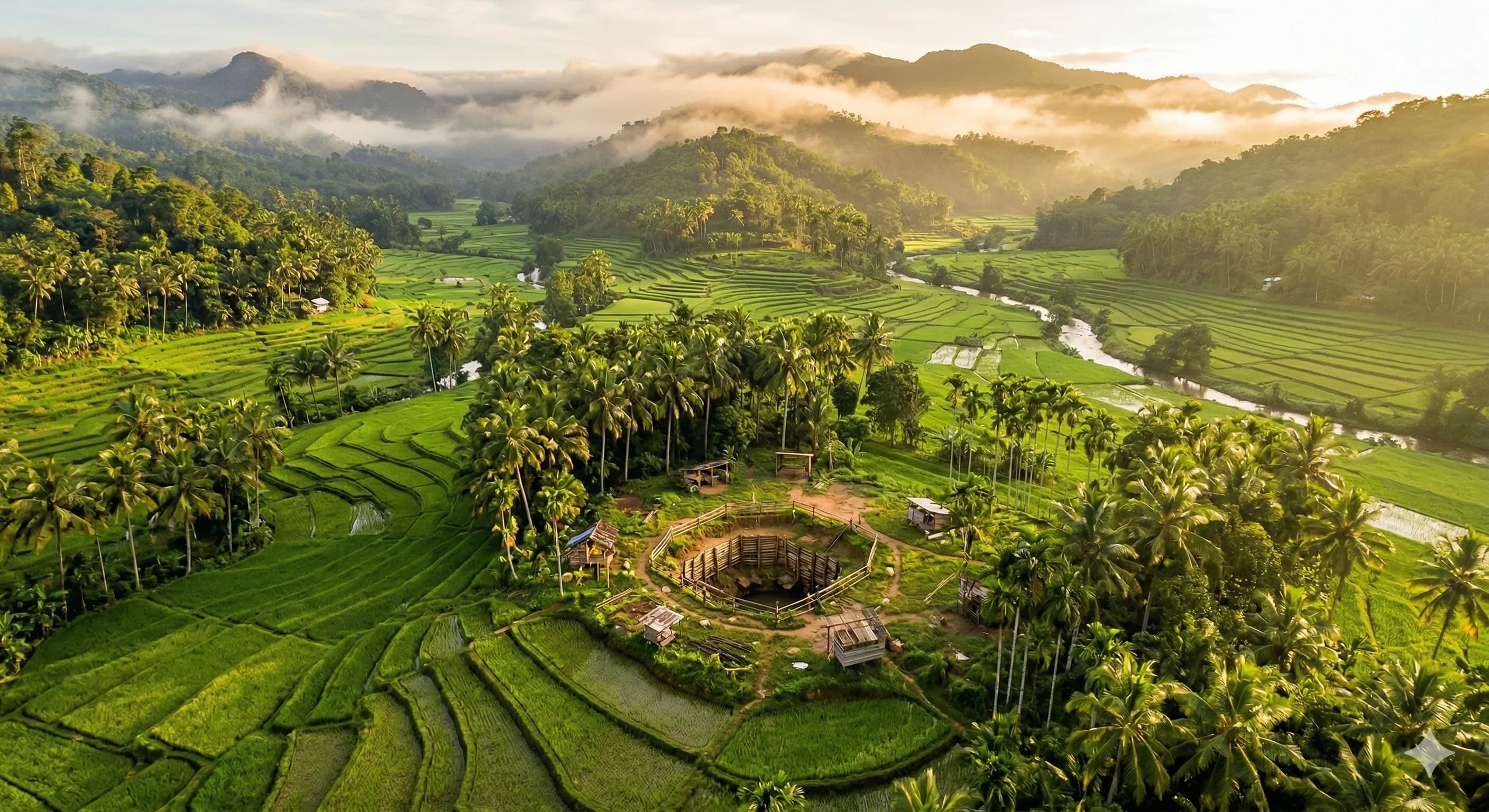
Sri Lankan gems are mined by hand from shallow alluvial pits, using methods that have barely changed in centuries. Teams of 5 to 15 workers sink a pit into gem-bearing gravel called illam, haul material to the surface in baskets, and wash it in river water to separate rough gemstones from ordinary rock. There is no blasting, no heavy machinery, and no chemical processing. The Ratnapura gem mines produce the majority of Sri Lanka's sapphires, rubies, spinels, and other precious stones through this traditional gem mining approach. The sri lanka gem mining process is one of the least mechanized and least environmentally destructive forms of mineral extraction on earth.
Here is how it works, from the initial dig through sorting and the first sale.
Where Are Gems Mined in Sri Lanka?
Sri Lanka's gem deposits are concentrated in the southwestern part of the island, in a geological zone geologists call the Highland Complex. The primary mining districts are:
Ratnapura. The center of everything. The name means "City of Gems" in Sinhalese, and the Ratnapura gem mines have been producing stones since at least the first century AD. The district sits in a river valley where millions of years of erosion washed gem-bearing minerals down from highland metamorphic rocks and deposited them in alluvial gravel beds. This is where the majority of blue sapphires, yellow sapphires, and padparadschas originate.
Elahera. A secondary mining area in the central highlands, roughly 150 kilometers northeast of Ratnapura. Elahera produces sapphires (particularly blue and geuda, the milky rough that transforms under heat treatment), along with star sapphires and occasional rubies.
Balangoda. South of Ratnapura, known for fine blue sapphires and spinels.
Meetiyagoda. On the southwestern coast, famous specifically for moonstone mining. The deposits here are shallow and the mining is even more low-tech than in Ratnapura.
Sri Lanka's geological luck is remarkable. The island is small, roughly the size of West Virginia, but it produces over 75 varieties of gemstone. Corundum (sapphires and rubies), chrysoberyl (including alexandrite and cat's eye), spinel, garnet, tourmaline, topaz, moonstone, and zircon all come from this single island. No other country of comparable size produces this diversity.
How Does Traditional Pit Mining Work?
The process starts with selecting a site. Licensed miners identify promising locations based on generations of local knowledge, geological indicators, and sometimes preliminary test pits. The National Gem and Jewellery Authority (NGJA) issues mining licenses that specify where and how deep a team can dig.
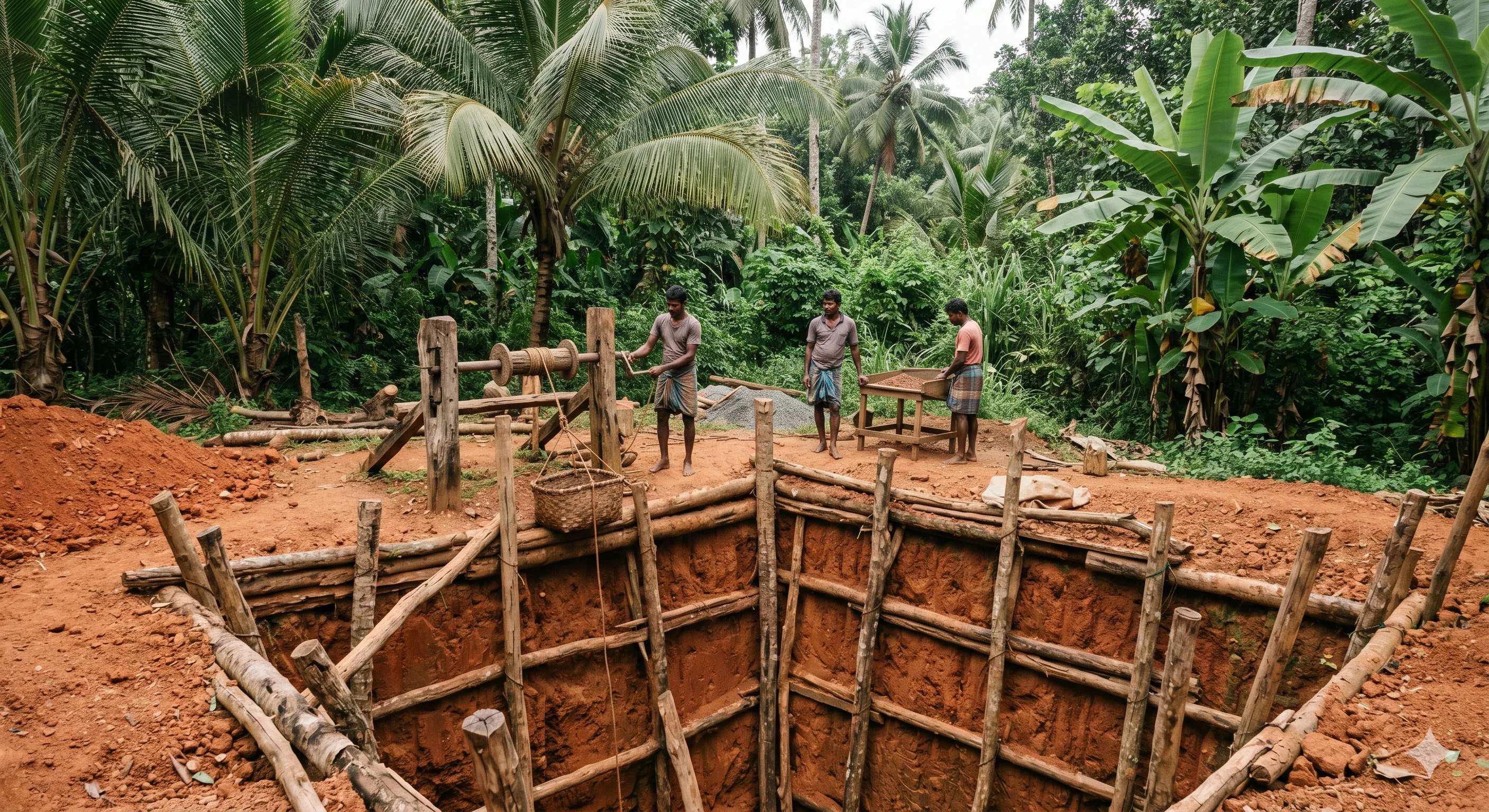
Once a site is selected, the team sinks a vertical shaft. The pit is typically 2 to 3 meters wide and descends 5 to 15 meters, depending on the depth of the gem-bearing gravel layer. The walls are reinforced with timber bracing as the pit deepens, a technique passed down through generations and adapted to local soil conditions.
The digging is manual. Workers use mammoties (a type of broad hoe), shovels, and crowbars to break through layers of clay and topsoil until they reach the illam. This gravel bed sits above the bedrock and is typically 30 centimeters to a meter thick. It consists of river gravel, sand, and clay mixed with whatever minerals the ancient rivers carried down from the highlands.
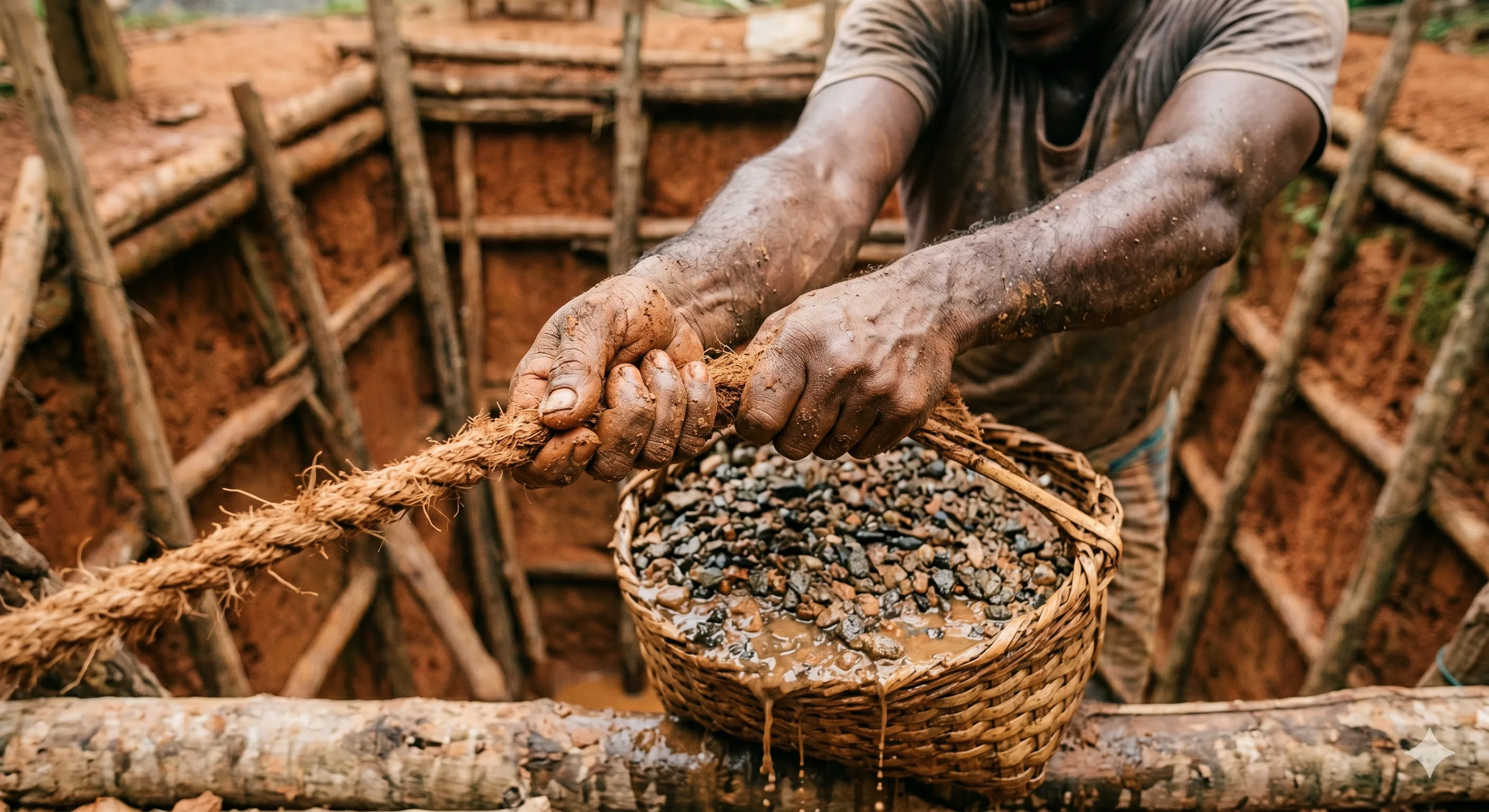
When the illam is reached, workers fill baskets with the material and haul them to the surface using a simple rope-and-pulley system. Some operations use a hand-cranked winch. Motorized pumps are the one modern concession: they keep groundwater from flooding the pit, a constant battle in Ratnapura's wet lowland climate.
The work is physically demanding. Miners spend hours underground in humid, cramped conditions. But the pits are shallow by mining standards, the teams are small and familiar with each other, and the skills are learned from childhood by watching fathers and uncles work.
How Are Gems Separated from Gravel?
This is where the process becomes both simple and skilled.
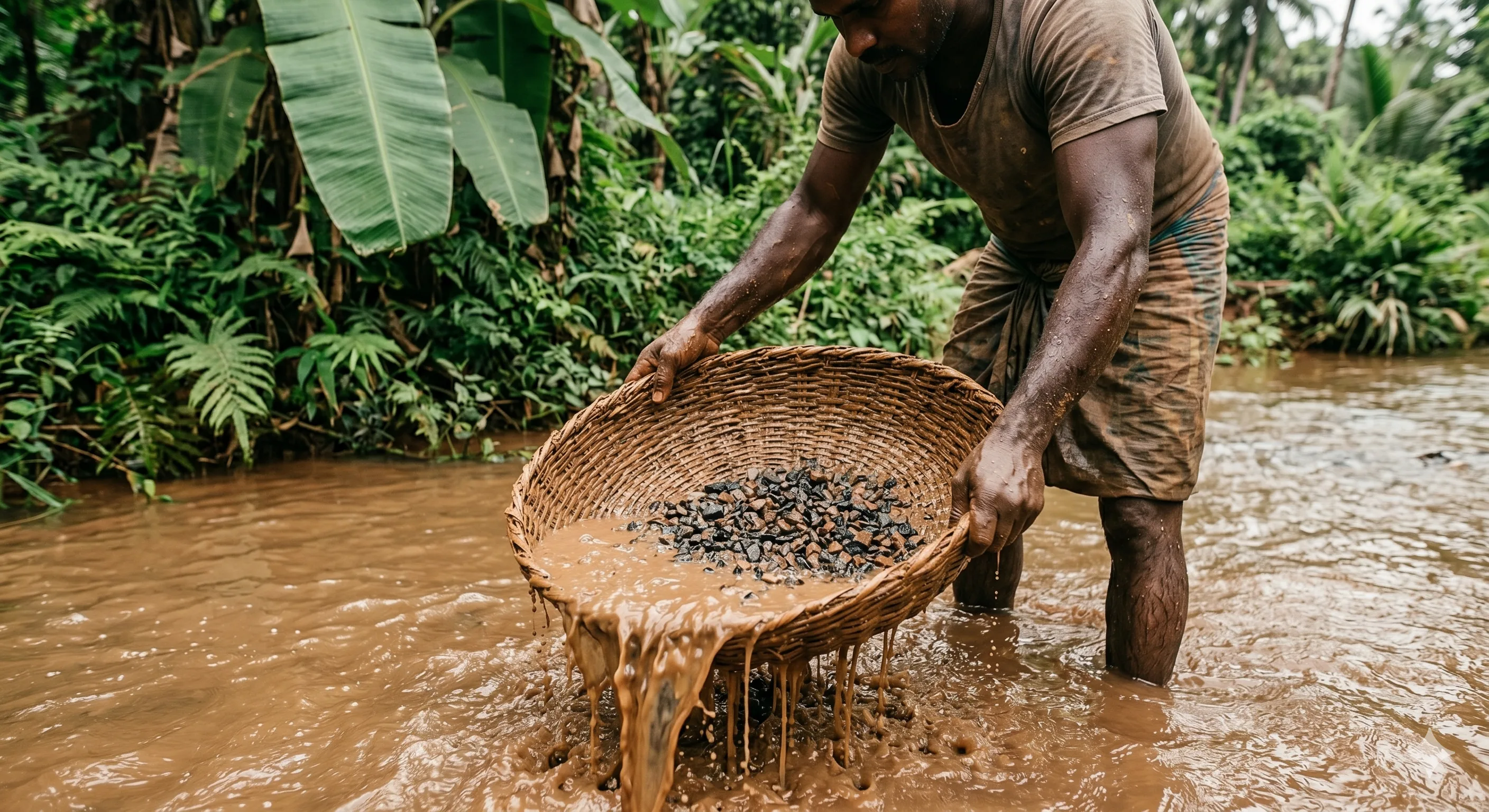
Baskets of illam are carried to a nearby stream or washing area. A worker stands waist-deep in water (or beside a sluice channel) and swirls the basket in a practiced circular motion. The lighter sand and clay wash away. The heavier minerals, including any gems, settle to the bottom. This gravity-based separation is the same principle used in gold panning, and it has been the standard method for centuries.
What remains after washing is a concentrate of heavy minerals: mostly dark-colored gravel, with the occasional flash of color. A senior member of the team, usually the pit boss or a designated sorter, examines the concentrate by hand. They are looking for the telltale signs of gem rough: the glassy luster of corundum, the specific gravity that makes a sapphire crystal feel heavier than a piece of quartz the same size, the distinctive crystal shapes.
This is where experience matters more than equipment. A good sorter can spot a piece of sapphire rough in a handful of wet gravel in seconds. They have been doing it for decades, often since they were children watching their parents sort. No machine, no spectroscope, no UV light. Just eyes, hands, and knowledge accumulated over a lifetime.
Once rough is identified, it goes into a separate container. At the end of the day or the end of a mining cycle, the accumulated rough is evaluated. The best pieces go to a cutter or directly to a dealer. Lower-grade material may be sold in bulk or set aside for heat treatment.
Who Are the People Mining Sri Lankan Gems?
Traditional gem mining in Sri Lanka is a community enterprise. Most operations are run by a pit owner (the license holder) who assembles a team from the local area. Workers are often relatives or neighbors. The arrangement is typically a profit-sharing model: the pit owner provides the license, equipment, and working capital; the miners provide the labor; and when gems are found, the proceeds are divided according to an agreed split.
This structure means that a productive find benefits the entire team, not just an owner. It also means that dry periods (and there are many; most pits produce nothing of significant value) are absorbed as a shared risk. The social dynamics are closer to a fishing cooperative than to an industrial mining operation.
The communities around Ratnapura are built on this industry. Gem dealers, cutters, polishers, brokers, and support trades form an interconnected local economy. A stone might be mined by one family, cut by another in the same village, and sold through a dealer the miner has known for twenty years. Sri Lanka's master gem cutters operate within walking distance of the pits, and the relationships are personal and multi-generational.
During one of our sourcing visits to Ratnapura, we spent an afternoon at a pit where the entire crew was from a single extended family. The father ran the operation. His two sons worked underground. A nephew handled the washing. The mother sorted the concentrate in the late afternoon light, squinting at wet gravel in her palm. When they found a small but clean blue sapphire rough that day, about 4 carats, the satisfaction was visible on every face. That stone would eventually become a heated blue sapphire of commercial quality, worth perhaps $400 to $600 after cutting. Split among the family, it represented a good day. Not every day is good. But the days that produce gems sustain the ones that do not. You can read more about our direct relationships with these communities and how they shape the way we source.
Every form of mining disturbs the earth. The question is scale.
Sri Lanka's alluvial gem mining is among the least destructive mineral extraction methods that exist. No chemicals are used at any stage. No mercury, no cyanide, no acid leaching. The separation of gems from gravel is entirely mechanical: water, gravity, and human hands.
Pits are shallow. They tap into existing gravel deposits in river valleys and flood plains. The material removed is a fraction of what a mechanized operation would process. And when mining concludes, the NGJA requires backfilling: the excavated material goes back into the pit, topsoil is replaced, and the land returns to agricultural use.
Visit Ratnapura and you will see active rice paddies directly adjacent to recently backfilled mining sites. Within one or two growing seasons, the land shows little evidence of mining activity. Compare this to the open-pit sapphire mines in Australia or the large-scale mechanized operations in Madagascar, and the difference in environmental impact is stark.
Water use is the one area where real impact occurs. Washing generates sediment-laden runoff that enters local waterways. The disturbance is localized and temporary, but it is real. Some operations now use settling ponds to reduce sediment discharge, a practice the NGJA encourages.
The environmental story is not "zero impact." It is "minimal impact, managed impact, reversible impact." For a buyer asking where their stone came from and what it cost the earth, that is a defensible answer. For the full picture of what ethical sourcing means for Ceylon sapphires, including labor laws and regulatory oversight, our ethics post covers it in detail.
From the Pit to the Market
The journey from rough crystal to finished gem involves several stages after extraction.
First, rough of quality is assessed by the pit owner or a visiting dealer. Price is negotiated on the spot, or the rough is taken to one of Ratnapura's gem markets. The most famous is the open-air dealing area near the city center, where hundreds of transactions happen daily under makeshift awnings.
Second, rough that shows promise goes to a lapidary for cutting. The cutter orients the stone to maximize color, plans the shape, and facets by hand on a traditional cutting wheel. This process can take days for a single stone.
Third, the finished stone may go for treatment. As covered in our post on unheated vs heated sapphires, the majority of commercial sapphires are heat-treated after cutting to improve color and clarity.
Fourth, the treated or unheated finished stone goes to a dealer or directly to a buyer. For Crestonne, this means stones we have personally inspected in Sri Lanka, sent to GIA or an equivalent laboratory for certification, and listed with full documentation. The chain from pit to listing is short, typically three to four steps, which is part of what keeps pricing transparent.
Explore the Crestonne collection to see certified stones from these mining communities, or submit a request through our custom sourcing service for something specific.